
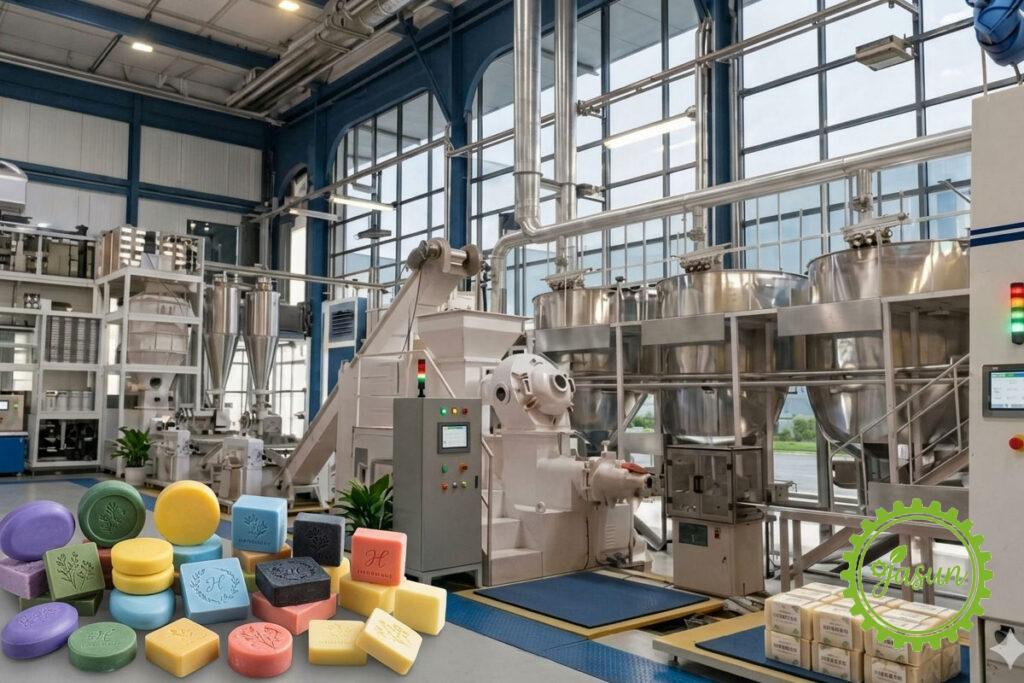
A complete soap production line turns vegetable oils and animal fats into finished soap bars. The process divides into two major steps. First, saponification creates a soap base from oils and caustic soda. This reaction is the classic step behind soap making. Then the soap production line dries, mixes, refines, stamps, and packs the finished bars.
Two stages of a soap production line
Part A — Saponification and vacuum drying (producing soap noodles)
Vegetable oils and animal fats react with caustic soda to form a soap base. Next, the soap base flows through a vacuum drying system and a pelletizer. As a result, these machines dry the base and form small pellets. The pelletizer then extrudes the dried soap into soap noodles. In addition, vacuum drying removes excess water for better noodle quality.
Part B — From soap noodles to finished soap
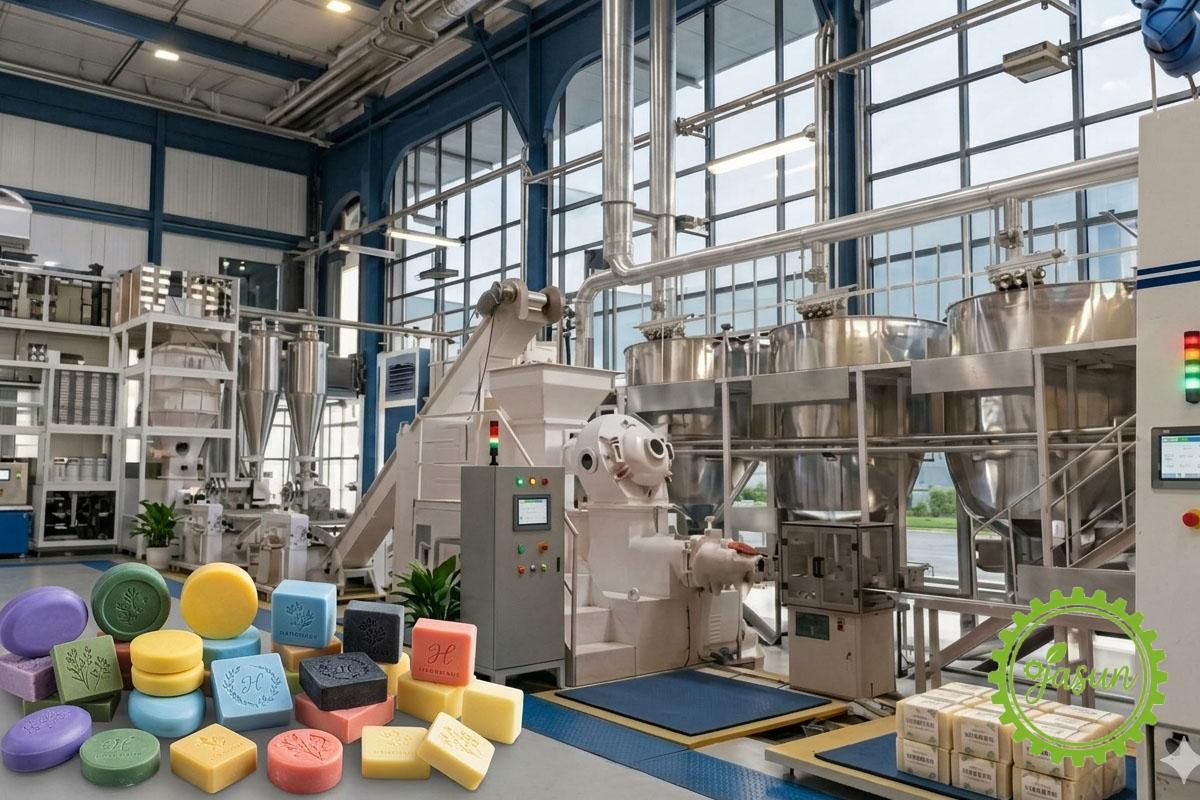
A soap mixer first receives the soap noodles. It blends the noodles with perfume and pigment. After that, a refiner plodder takes the mixture and mills it thoroughly. The machine blends, homogenizes, and mills the soap material into a smooth texture.
Then the material moves to a three-roll mill (a three-roller grinder). The mill grinds the soap into thin sheets. A conveyor belt carries these sheets to a vacuum plodder. This soap production line can use a duplex vacuum soap plodder or a single-screw soap plodder. Both machines refine the soap and extrude it into a long bar with the desired shape.
Finally, an automatic soap cutting machine cuts the long bar into individual bars. A soap stamping machine then shapes and embosses each bar. You may also know this machine as a soap stamper, soap printer, soap press, or soap punching machine. At the end, a packaging machine wraps the finished bars. It handles flow pillow packing, cartoning, and paper wrapping.
For most beginners with no experience in soap manufacturing and a small budget, we recommend starting with Part B. Ready to pick equipment? Compare all soap making machines and production lines by capacity and configuration.