
1.Equipment Flow and Process Description for Agglomeration Method
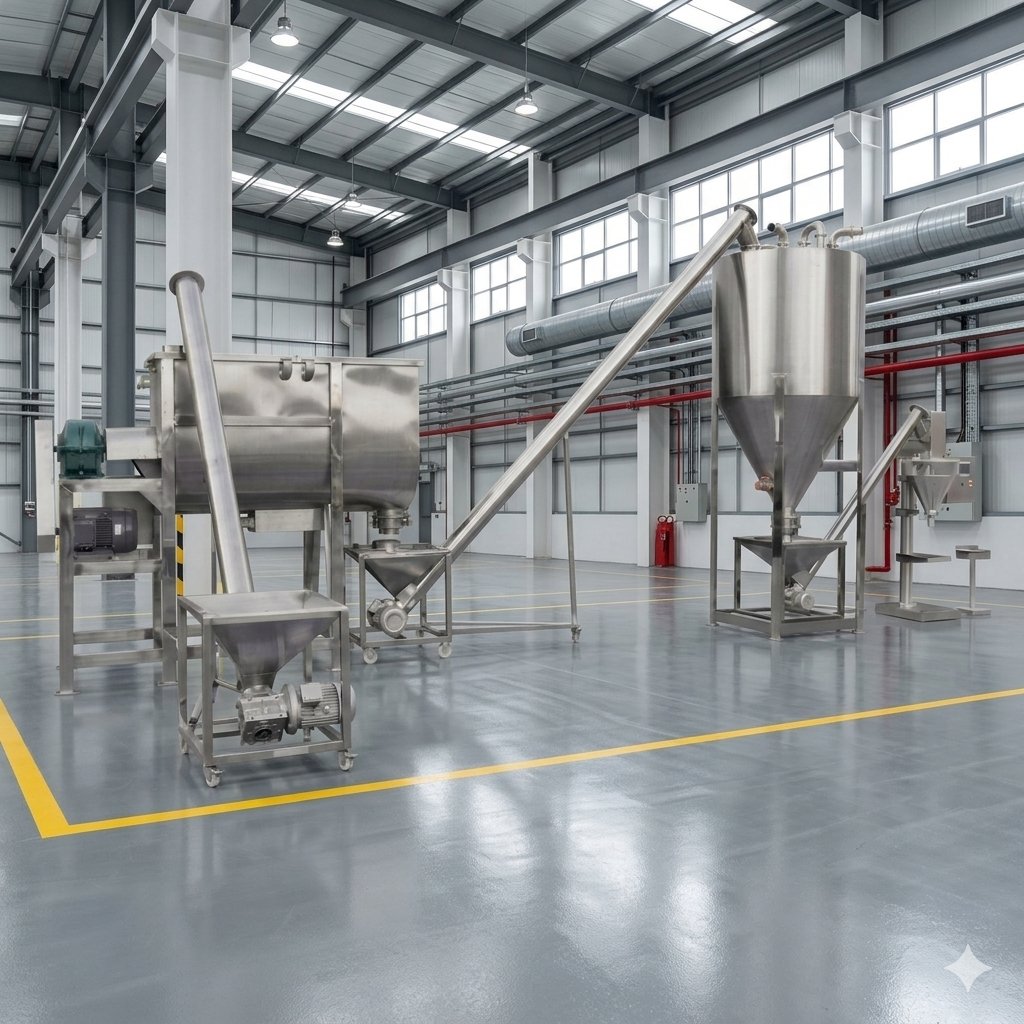
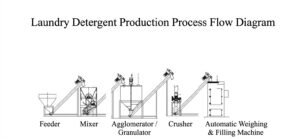
The agglomeration production line consists of the following core engineering units, enabling an automated and continuous operation from raw material intake to final product packaging:
* Feeder: Responsible for the stable, uniform, and metered feeding of various solid powder raw materials into the subsequent processing units.
* Mixer: Performs highly efficient and homogenous dry blending of the incoming multi-component powders to ensure uniform distribution of the formulation.
* Agglomerator / Granulator: The central unit of the process. By utilizing mechanical agitation or fluidization states combined with a liquid binder, it forces powder particles to collide and agglomerate into dense, solid granules.
* Crusher: Dedicated to grinding and refining the oversized lumps screened from the process, allowing them to be recycled back into the production loop.
* Automatic Weighing & Filling Machine: The high-efficiency terminal packaging unit that automatically executes precise metering, filling, sealing, and weight-sorting of the finished granular detergent.
2.Technical Description of Main Production Processes and Packaging for Detergent Powder
The main production and shaping processes for detergent powder are the high-tower spray drying method and the agglomeration method.
In the high-tower spray drying method, the raw materials are mixed with water in appropriate proportions to form a free-flowing slurry. The slurry is filtered, pressurized, and then atomized into the spray drying tower through nozzles at the upper section, while hot, dry air is introduced from the bottom. Inside the tower, the descending detergent droplets come into full counter-current contact with the rising hot air, drying the slurry into hollow, free-flowing granules ready for subsequent processing and packaging.
The agglomeration method can be classified into mechanical agitation agglomeration and fluidized bed agglomeration, depending on the granulation mechanics and fluidization states of the solid powder. This method involves blending specific ingredients of the detergent formulation in precise proportions, then forming them into dense granules using granulation equipment. The resulting granules are sieved; the qualified granules proceed to the next stage, while oversized lumps are crushed and recycled back into the system. Finally, they are conveyed to the packaging machine.
In terms of product characteristics and energy consumption, these two processes exhibit distinct differences:
* Product Density and Morphology: The high-tower spray drying method produces hollow granules with a low bulk density (typically 0.25–0.45 g/cm³), yielding the conventional or “regular” laundry powder commonly found on the market, which dissolves rapidly in water. Conversely, the agglomeration method yields dense, solid granules with a high bulk density (typically 0.60–0.90 g/cm³), making it the primary technology for “concentrated” or “compact” detergents that feature smaller packaging volumes for efficient transport and storage.
* Energy Consumption and Thermal Efficiency: The high-tower spray drying method is an energy-intensive process, demanding substantial thermal energy (typically supplied by natural gas or coal) and electrical power to evaporate large amounts of free water from the slurry. In contrast, the agglomeration method relies primarily on the mechanical blending of solid powders with a minimal amount of liquid binders. It requires little to no high-temperature heat sources, resulting in significantly lower overall energy consumption and carbon emissions compared to the spray drying method.
Powder packaging machines are designed for the automatic packaging of free-flowing or semi-free-flowing granular materials into small bags. They automatically perform bag forming, metering, filling, sealing, weighing, and sorting. Their precise engineering ensures product quality while maximizing production output.